







Percutaneous Hair Transplant
Category: Hair

Treatment Details
Session
1
Operation length
6-8 Hours
Anesthesia
Local
Discomfort period
1-3 days
Return to work
3 days
Full recovery
10 Days
Results
Permanent
Hospital stay
No
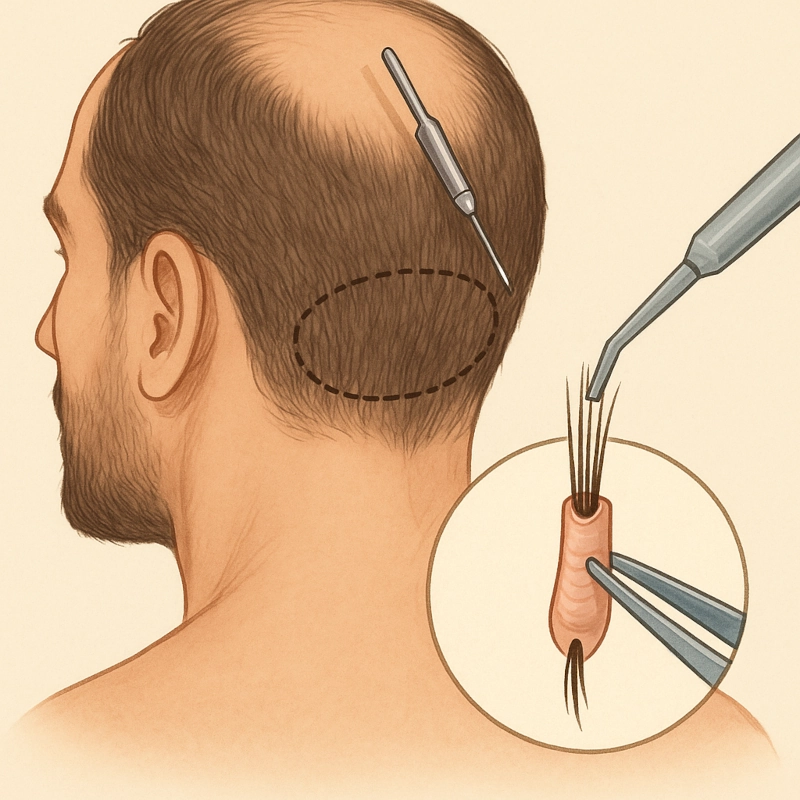
Percutaneous hair transplantation is a refined method for opening channels for hair follicles. Using special needles creates a very natural result with high density.
Fact Check
- Technique: Opening of channels with fine needles instead of blades.
- Advantage: Control over growth direction and angle of the hair for a natural look.
- Density: Allows for higher hair density (approx. 45-55 grafts per cm²).
- Healing: Faster healing and less crust formation compared to conventional methods.
- Duration: The procedure takes approx. 6-8 hours.
- Result: Natural appearance and high survival rate of grafts.
FAQ
What is the difference to normal FUE?
The difference lies in the opening of the channels; the percutaneous method uses needles for finer holes.
Is healing faster?
Yes, since the channels are rounder and smaller, the scalp often heals faster.
Does the result look more natural?
Precise control of the angle allows for a very natural growth pattern.